At the SATO Group, we believe sustainable management is a corporate imperative for achieving long-term growth and lasting value. Guided by our corporate mission to contribute toward a better and more sustainable world, we have consistently integrated sustainability into our business strategy. In 2019, we identified our material topics and established the Sustainability Promotion Committee, which reports directly to the Executive Officers Meeting and drives our sustainability initiatives forward.
As the global business environment rapidly transforms, corporations are expected to take greater responsibility for social and environmental issues while also driving technological advancement. To integrate these changes into our business strategy and work toward our 2030 vision, we have updated our materiality assessment to clarify our priorities.
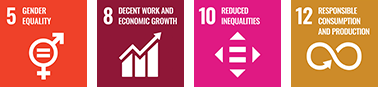
We strive to advance our sustainability initiatives with a clear purpose, contributing to the Sustainable Development Goals (SDGs) that are closely tied to our material topics.
Materiality Assessment
SATO Group's material topics and SDGs
Defining our material topics
Our material topics were identified through discussions with internal board members and executive officers. We assessed how evolving environmental and social issues, including climate change and human rights, may impact our business activities from the perspectives of both risk and opportunity.
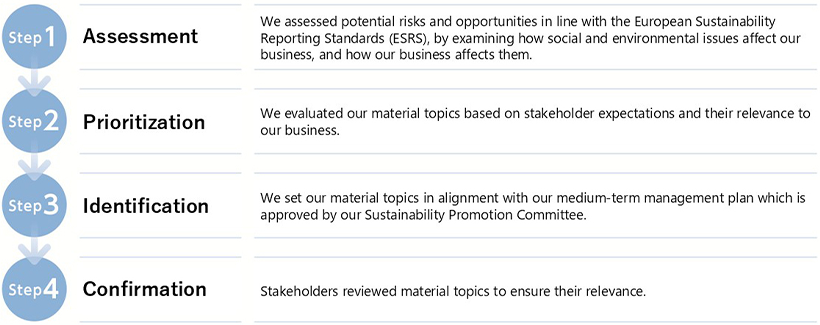
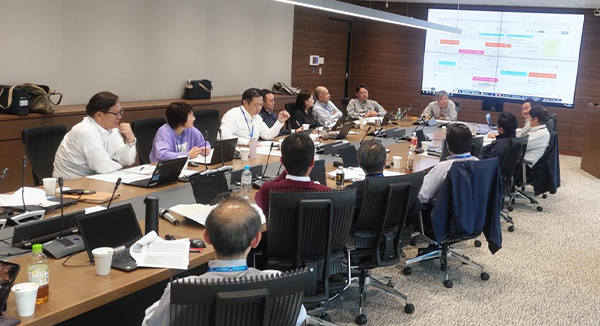
Each material topic is assigned KPIs by the responsible executive officer, and progress is regularly reviewed by the Sustainability Promotion Committee. We also periodically reassess our material topics to reflect changes in the business environment and evolving social trends.
Our approach to materiality
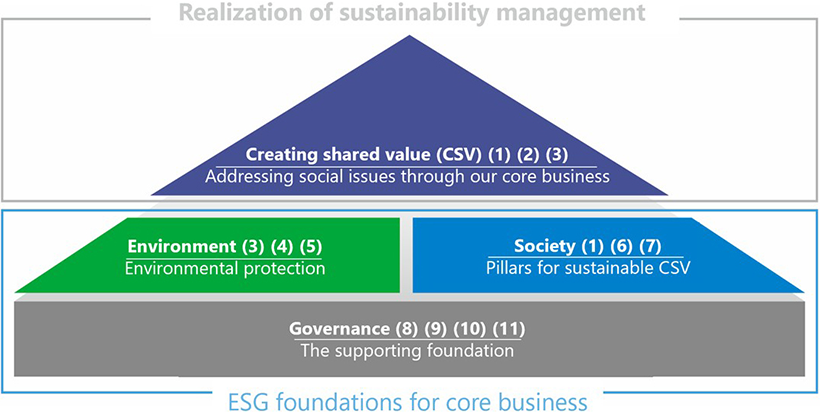
SATO Group's newly defined material topics serve as a guiding principle for promoting sustainable management by executive leadership, as set out in our medium-term management plan.
We address social issues such as environmental conservation and human rights protection, while enhancing employee engagement and community contribution as a responsible corporate citizen.
This foundation drives innovation and business transformation, further strengthening our auto-ID technology to support sustainable growth and long-term value creation.
Materiality overview
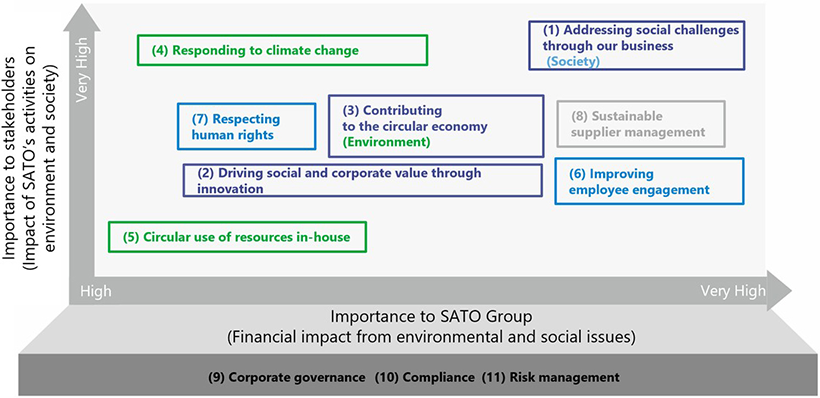
Materiality matrix
Dialogue with subject-matter expert
- Date & time
-
March 19, 2026, 2–4 p.m. (JST)
- Participants
-
(External)
Norio Masuda
Co-Representative Director, ESG Disclosure Study Group
Senior Manager, Sustainability Promotion Division, Hitachi, Ltd.(SATO)
Takeshi Okamoto
Executive General Manager, Japan Sales HQ
Tetsuya Takashima
Senior Manager, Sustainability Promotion Dept
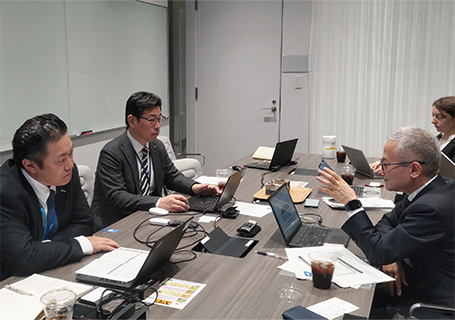
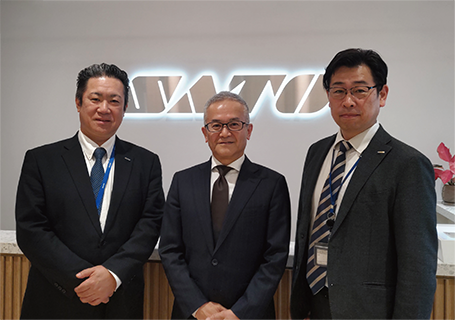
During the stakeholder dialogue, we received the following comments:
- SATO demonstrates a consistent commitment to placing sustainability at the core of its business and creating social value through its operations, which is commendable.
- SATO’s materiality assessment process is strategic and calibrated as it takes into account both internal discussions and insights from external stakeholders.
- SATO is clear about making sustainability its business priority through creating shared value, which involves generating economic value while simultaneously reducing the negative impact from social and environmental issues.
- SATO is not a B2B company. One of its greatest strengths is that it generates value across the value chain and society as a BtoS (business-to-society) company through traceability and other solutions.
- It is increasingly important for companies to create financial and non-financial value, linking their social and environmental contributions to corporate value creation.
- Companies must learn how best to empower their business units and employees to take ownership of sustainability in their daily work.
- Sustainability is not just a trend. It is important that companies embed sustainability in their corporate culture that continues even through leadership changes.
Through this dialogue, we reaffirmed our approach to assessing materiality with a focus on creating shared value to solve social issues for a better and more sustainable world. At the same time, it highlighted areas for improvement, particularly in defining and communicating how our business benefits society and the environment, which is important if we want to raise our corporate value and deepen stakeholder understanding. The dialogue also provided a good opportunity for us to go back to basics and rethink who we serve and why we do business. We will continue to create value for society in line with the expectations and trust placed in us by our stakeholders.
Materiality KPIs
In 2025, we started setting KPIs for selected material topics. Our KPIs for topics related to creating shared value can be found here.
Material sustainability issues and related SDGs
Creating shared value (CSV)
Addressing social issues through our business
Related SDGs

Environment
Policy
Environmental protection
Related SDGs

Society
Policy
Pillars for sustaining CSV
Related SDGs

Governance
Underlying foundation
Related SDGs