Reducing carbon dioxide emissions is essential to tackling global warming and contributing to a sustainable world. We understand that we are responsible for the environment, and work to monitor the carbon footprint of our business activities and promote tangible initiatives to stop global warming.
We have set medium- to long-term targets with the aim of halving groupwide Scope 1 and 2 emissions from FY 2019 levels by FY 2030.
Greenhouse Gas Emissions
The base year has been set as FY 2019 (previously FY 2016 for Scope 1 and 2 emissions and FY 2021 for Scope 3 emissions) because it is the earliest year with complete and verifiable data that reflects the company's typical emission profile.
Medium- to long-term targets and their progress
SATO's targets and progress for carbon dioxide emission reduction
| Area | Key indicators | FY 2019 results | FY 2023 results | FY 2024 results | FY 2025 results | FY 2030 targets |
|---|---|---|---|---|---|---|
| Groupwide | Scope 1 and 2 CO2 emissions | 14,570 | 13,152 | 10,939 | 9,635 | 7,285 |
| Relative to FY 2019 | - | Down 9.7% | Down 24.9% | Down 33.9% | Cut by 50% | |
| Scope 3 CO2 emissions | 563,714 | 562,945 | 582,630 | 440,614 | 281,857 | |
| Relative to FY 2019 | - | Down 0.1% | Up 3.4% | Down 21.8% | Cut by 30% |
FY 2025 recap
In FY 2025, we reduced groupwide Scope 1 and 2 emissions by about 12 percent through the use of renewable energy at our printer factories year round and transitioning to renewable energy at our Japan sales offices. Currently, 36.1 percent of our electricity usage comes from renewables. (Japan: 64.3 percent, other countries: 20.5 percent)
To improve the accuracy of Scope 3 emissions, we revised the calculation method for domestic suppliers under Category 1 (Purchased goods and services). The previous method, which used carbon footprint results for label products, was replaced with a method incorporating the results of a 2025 assessment and primary data provided by suppliers. Details of the retrospective application of this change to prior-year emissions and the recalculated results are provided here. This change has enabled the SATO Group to more accurately understand actual emissions across its supply chain. We will continue working to further reduce emissions through initiatives listed below.
Action plans
Globally, we will continue cutting our Scope 1 and 2 emissions, starting with the highest-emitting sites. We will also accelerate our renewable energy transition and other emissions reduction efforts.
Data shows that emissions associated with purchased goods and services (Category 1), use of sold products (Category 11) and end-of-life treatment of sold products (Category 12) account for the bulk of our Scope 3 emissions. We will use EPD (Environmental Product Declaration) results to improve transparency about the environmental impact of our key products over their life cycle and make stronger efforts to cut their emissions quantitatively.
We will also continue to expand our printer take-back program and recycling of used ink ribbons and discarded label liners while developing and offering solutions that help customers reduce emissions in their operations and contribute to a circular society.
Renewable energy sources
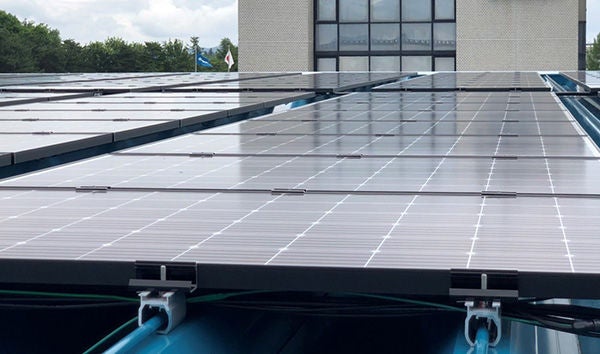
In addition to using solar power at several printer factories and Japan locations, we also purchase electricity, increasingly from renewable sources instead of fossil fuel sources. Globally, six SATO locations now operate on renewables.
LED lighting for energy conservation
We began installing energy-efficient LED fixtures in Japan since FY 2019 and have successfully converted 43 percent of our lighting to LED as of FY 2025.
Efficient use of resources
We make efficient use of resources in various ways such as recycling our printers and label liners and using recycled plastics and other eco-friendly materials in our products.
Online technical support
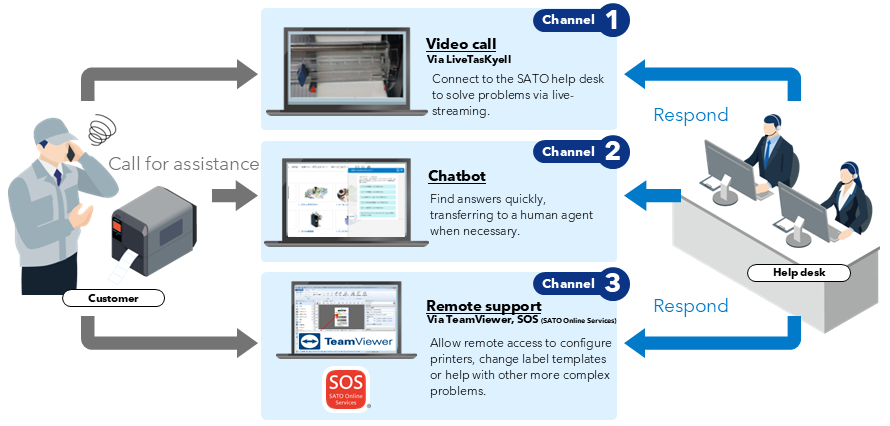
With the use of video calls, chat and remote access tools, our service engineers can provide online support and guide customers through printer repairs without travelling to their worksites. Fewer service trips means less travel-related emissions. In FY 2024, we achieved 21.5 metric tons of carbon savings from reduction in travel and fuel consumption.
Online technical support also enables faster response times, resulting in higher customer satisfaction.
Quick replacement service
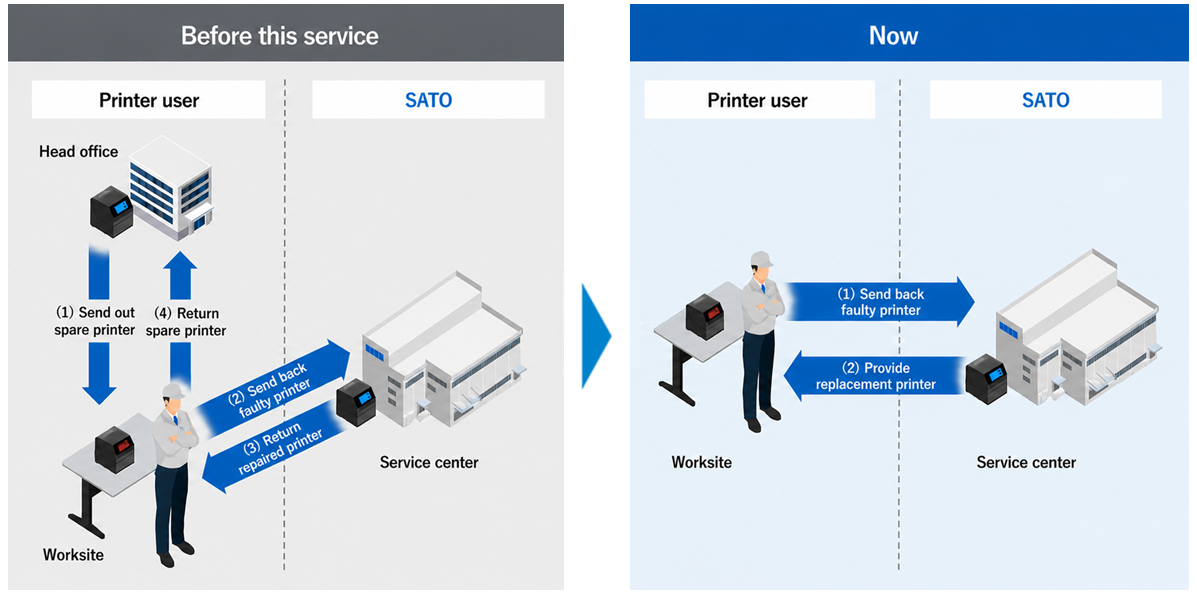
When printers break down, the customer can arrange for faulty printers to be sent to our service centers and for replacement printers to be used at their place of operations (while we repair faulty units and keep them as the new standby). In this way, printers only travel between the customer site and our service centers. Instead of requiring the head office to send a spare printer, the user can reduce points of movement and the associated carbon footprint with this service.