

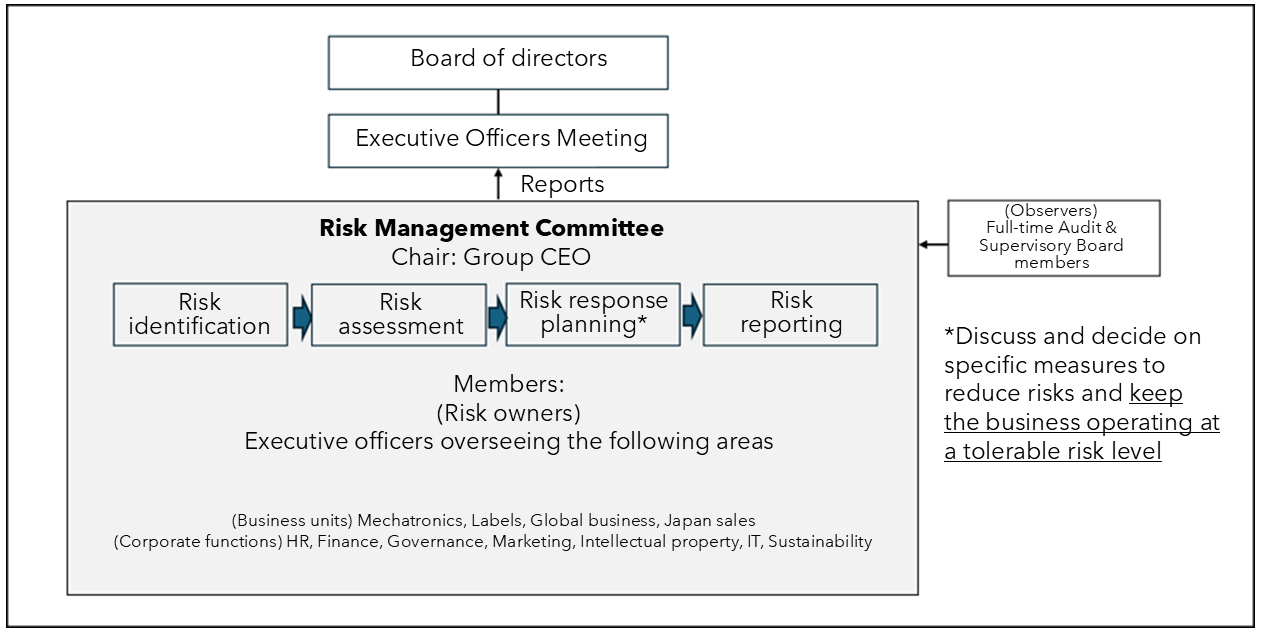
In accordance with its risk management rules, the SATO Group operates a risk management framework that entails identifying, assessing and responding to internal and external risks across group companies. Executive officers serve as risk owners for their respective areas, while our Risk Management Committee identifies, assesses and reviews significant risks, develops countermeasures and monitors the effectiveness of risk management activities, reporting to the Executive Officers Meeting and board of directors regularly. It also establishes a crisis management team to provide a swift and appropriate response when risks materialize.
Risk Factors
(1) Risk management framework
(2) Risk assessment
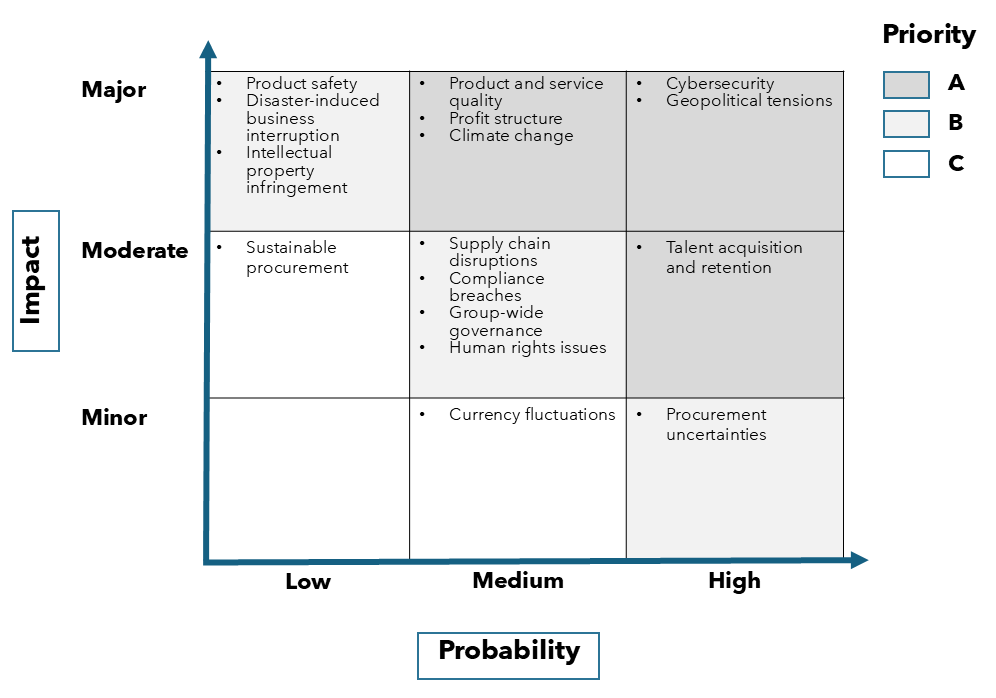
We evaluate risks according to their likelihood of occurrence and impact, plotting the results on a risk matrix as follows to determine priority.
(3) Risks and controls
Operations
Risk | Procurement uncertainties | ||
|---|---|---|---|
| Rating | Impact Minor | Probability High | Priority B |
| Risk description | Difficulty procuring electronic components to make our printers due to component shortages or reaching EOL (end-of-life) could result in prolonged production interruptions and product shortages. | ||
| Mitigation measure | We take a strategic and systematic procurement approach to ensure a stable supply of product parts for business continuity. First, we perform yearly supplier reviews to monitor and identify EOL risks at an early stage. We also plan for the long term with a clear procurement policy and roadmap for EOL parts management. While qualifying an alternative component typically requires approximately one year, the Group has strengthened its change management processes to accelerate the identification and evaluation of replacement parts, helping to minimize the risk of production delays or supply disruptions. We also hold regular meetings with suppliers and specialized retailers to collect and track information on the discontinuation of key parts including power supplies, batteries, cutters and thermal printheads. This allows us to plan and prepare for EOL notices in advance. In our R&D process, we integrate product lifecycle management to check for and block phase-out parts so that we do not end up having to redesign new products shortly after their launch when some parts become obsolete. As semiconductor prices surge and shortages persist, we place advance purchase orders to secure priority allocation even amid lead time volatility, ensuring we have sufficient supplies to meet planned production volumes. We will continue improving productivity to absorb rising costs while raising product pricing as necessary to adapt to changing market conditions and protect profits. We aim to manage both procurement risks and their financial impact to achieve operational stability through the above measures. | ||
Risk | Sustainable procurement | ||
|---|---|---|---|
Rating | Impact Moderate | Probability Low | Priority C |
Risk description | Our key factories in Japan, Malaysia and Vietnam procure parts from diverse suppliers. If environmental degradation, human rights abuses or other compliance issues occur across the supply chain, we may be held accountable for our procurement decisions and lose public trust. | ||
| Mitigation measure | We work to strengthen sustainable procurement under our key policy to source products and materials responsibly across the supply chain. Before initiating partnerships with new suppliers, we assess them for compliance with our sustainable procurement policy and guidelines to minimize risks from the start. In addition, we include provisions concerning sustainable procurement in our basic purchase agreements and partnership contracts for our suppliers to understand and comply with them. We aim to achieve supply chain compliance and sustainable operations through the above measures. | ||
Risk | Supply chain disruptions | ||
|---|---|---|---|
Rating | Impact Moderate | Probability Medium | Priority B |
Risk description | We operate factories in Japan, Malaysia and Vietnam, together with sales offices around the world. If production and logistics are disrupted by worsening geopolitical tensions, natural disasters, extreme weather events, pandemics or labor strikes, we may face rising shipping costs and delays in incoming procurement and outgoing shipments. If we cannot meet demand and end up losing sales opportunities and customers, our business performance will be affected adversely. | ||
Mitigation measure | We make various efforts to mitigate supply chain risks for production and logistics continuity. First, we use sales forecast data to calculate how much we must buffer for critical parts including long lead-time items, maintaining safety stock to absorb shocks from unexpected supply interruptions and demand swings, so that we can sustain production and keep delivering products to customers. Second, we diversify our suppliers to spread out risks and avoid relying on a single source. This protects our operations from external events like natural disasters to minimize their impact. Lastly, we follow a change management workflow for those production inputs that we source from a single supplier due to technical exclusivity. For example, we will prepare notifications about 4M (Manpower, Machine, Material, Method) change points and submit them to customers for approval. With a structured workflow, we can prevent quality defects and shift to mass production smoothly when changes occur, minimizing their impact. | ||
Risk | Product and service quality | ||
|---|---|---|---|
Rating | Impact Major | Probability Medium | Priority A |
Risk description | Through our DCS & Labeling business model, we combine products and software/services designed (and manufactured) in-house with products/technologies of our partners to offer solutions for customer pain points. But as we procure an increasing number of third-party products and develop custom software with ever increasing technical complexity, unexpected quality issues may occur because our QA (quality assurance) teams do not have enough time for thorough testing. Poor quality control will affect how well our products and services sell in the market. | ||
Mitigation measure | Ensuring product and service quality is one of our key priorities in business management. In the case of custom products, we prepare requirements documents for the customer’s review to establish a mutual understanding and agreement on the final specifications before starting development. To assure quality standards, our QA teams also test the developed products to check that they work exactly as they should, putting together test summary reports for the customer’s formal approval. For high-risk custom software development, responsible managers (from the Solutions Business Division, etc.) can conduct budget reviews to assess the project’s financial feasibility and make the necessary decisions to prevent unacceptable risks. In addition, managers, software engineers and sales personnel across our group companies receive regular awareness training on the risks and important considerations for software projects. In product and service contracts, we provide clear clauses that help reduce patent infringement and other risks (starting from the sales quotation stage) and limit liability when disputes do arise. Also, we have established a Product Security Incident Response Team (PSIRT) to take appropriate actions immediately when security incidents are identified. | ||
Risk | Product safety | ||
|---|---|---|---|
Rating | Impact Major | Probability Low | Priority B |
Risk description | If we conduct mass product recalls due to safety standards, battery hazards, regulatory non-compliance or quality issues, we may lose customer and public trust, which would affect our business performance adversely. | ||
Mitigation measure | We make mitigating product safety risks one of our key priorities in business management, working to rigorously manage internal processes from R&D to final delivery. First, our R&D teams follow standard protocols in new product development, implementing testing and quality control during the design phase to prevent safety incidents and rework. This minimizes the risk of defects after product launch and helps safeguard customer satisfaction. When safety incidents occur, we will carry out rework, inform affected customers and take other necessary actions with speed based on our response manual to contain damage and restore trust. Before initiating partnerships with new suppliers, we assess them for compliance with safety and quality standards through supplier audits. We also perform yearly supplier reviews to verify continued compliance, ensuring supply chain quality control to meet our requirements for supply stability and product quality. | ||
Risk | Profit structure | ||
|---|---|---|---|
Rating | Impact Major | Probability Medium | Priority A |
Risk description | At SATO, we practice genbaryoku, which is about understanding how things work on site to offer one-stop solutions that address customer points. Because our solutions cover everything from products and services to their maintenance and are tailored to individual customer needs, it takes time, effort and careful coordination to build them. As such, our share of SG&A (selling, general and administrative) expenses is generally higher than industry peers. This means that we have a higher break-even point and that our business is more vulnerable to drops in sales. | ||
Mitigation measure | As the market in Japan slows down, we must seek sustainable growth by expanding globally. We are localizing our sales strategies based on regional demands and market trends to seize new growth opportunities. To build a more stable profit base, we are also putting in stronger efforts at the global level to win orders for consumables products and maintenance services that contribute to recurring business. In this way, we can prevent sudden drops in sales and diversify our business portfolio to mitigate risks and their impact on our financial performance. | ||
IT
Risk | Cybersecurity | ||
|---|---|---|---|
Rating | Impact Major | Probability High | Priority A |
Risk description | Cyberattacks on the company may cause the personal and confidential data we handle to be stolen, modified or destroyed and result in system disruptions. As cyberattacks targeting IoT infrastructure increase in recent years, vulnerabilities in our product and service security may facilitate cyberattacks on the customer’s systems, exposing their data to unauthorized access. If the above happens, we may lose customer trust and brand reputation, which would affect our business operations and performance adversely. | ||
Mitigation measure | Ensuring information security is an important business imperative for SATO. First, we adopt technical defenses using, for example, Unified Threat Management (UTM), which combines multiple security functions into a single gateway between our local network and the external internet to provide comprehensive protection. We also use Endpoint Detection and Response (EDR) and continuous network security monitoring, to catch and block malicious activity in end-user devices in real time and to identify unusual communication patterns before they become cyberattacks. Second, we establish a Computer Security Incident Response Team (CSIRT) and Product Security Incident Response Team (PSIRT) to take appropriate actions immediately in the event of security incidents. We apply the latest security patches, conduct regular security posture assessments and strengthen firmware security to prevent our printers from being exploited as vectors for cyberattacks. We also build system redundancy to keep services running during cyberattacks while backing up data regularly to safeguard against data loss or corruption and enable quick recovery. Lastly, we regularly train employees on how to manage internal information assets properly and run Advanced Persistent Threat (APT) drills to enhance employee security awareness and response to cyberattacks. | ||
Human resource
Risk | Talent acquisition and retention | ||
|---|---|---|---|
Rating | Impact Moderate | Probability High | Priority A |
Risk description | If competition in the labor market intensifies, we may face challenges with attracting and retaining skilled employees. Talent and labor shortages could weaken our R&D capabilities and compromise our product competitiveness and supply stability to affect our business performance adversely. | ||
Mitigation measure | We value workplace improvements and talent development, taking efforts to create a conducive environment for our diverse workforce. Besides introducing remote work and flextime, enhancing employee benefits and promoting diversity, equity and inclusion (DE&I), we also aim to ensure employee well-being through health screenings and support for mental health. In terms of talent development, we provide e-learning to help employees understand our corporate values, upgrade their knowledge and grow their careers while retraining managers to refine their leadership skills. To improve overall engagement more effectively, we have also set up an employee engagement subcommittee under the HR Development Committee and added the employee engagement score as a key performance indicator for executive remuneration. Through the said subcommittee, our senior executives will lead and drive activities related to workstyle innovations and DE&I, among other things. | ||
Governance
Risk | Compliance breaches | ||
|---|---|---|---|
Rating | Impact Moderate | Probability Medium | Priority B |
Risk description | We do business in a global environment where public sentiments, laws and regulations change from time to time. If we do not match our policies and measures promptly and flexibly, ethical or compliance lapses may arise to affect brand reputation and credibility and even threaten the company’s sustainable growth and valuation. | ||
Mitigation measure | We identify the licenses, permits and other regulatory requirements applicable to our business, taking the necessary steps to comply with them in our operations. For high-risk areas such as antitrust compliance and anti-bribery and corruption compliance, we manage them through relevant teams and enforce them with clear internal rules and regulations while training employees on their importance. We also provide a supplier hotline to let suppliers report concerns and complaints for our corrective actions. Our governance department takes charge of developing, running and managing internal controls. It gets internal departments to revise or establish new rules and regulations as necessary and ensures job duties at SATO Group companies are executed in compliance with laws and their respective articles of incorporation. It also works to reinforce the importance of internal rules and regulations, sharing information on compliance breaches with all employees to raise awareness and strengthen deterrence. To maintain sound governance, the company also provides a whistleblowing channel for employees to report any suspected violation of laws and regulations so that follow-up and corrective actions can be implemented accordingly with speed. | ||
Risk | Group-wide governance | ||
|---|---|---|---|
Rating | Impact Moderate | Probability Medium | Priority B |
Risk description | If the headquarters in Japan cannot adequately monitor group companies around the world, accounting fraud, embezzlement or other forms of corporate misconduct may occur. | ||
| Mitigation measure | We appoint officers from the headquarters to help prevent misconduct and legal violations at key group companies, reducing their compliance risks for stronger governance. We also provide coaching and training programs to change the mindset of local managers to make them more governance-aware when training local employees to embed a culture of compliance at the group level. To maintain sound group-wide governance, we also provide a whistleblowing channel for employees to report any unlawful or improper conduct so that follow-up and corrective actions can be implemented accordingly with speed. | ||
Intellectual property
Risk | Intellectual property infringement | ||
|---|---|---|---|
Rating | Impact Major | Probability Low | Priority B |
Risk description | We may receive warnings from third parties alleging infringement of protected IP and demanding that we cease sales of specific products and compensate their losses. Also, we may face IP lawsuits and need to halt business. | ||
Mitigation measure | As part of our global policy, we make sure to respect IP rights and avoid any related risks that could lead to criminal penalties or other serious consequences by incorporating freedom-to-operate investigations into our new product/service R&D schedules. Our IP Department also monitors competitor patent activity continuously, sharing its analysis regularly with relevant departments for their action as necessary. | ||
Natural disasters
Risk | Disaster-induced business interruption | ||
|---|---|---|---|
Rating | Impact Major | Probability Low | Priority B |
Risk description | Large-scale natural disasters, accidents or incidents could disrupt production and operations at other sites, resulting in temporary interruptions to product shipments and sales. | ||
Mitigation measure | We make various efforts to mitigate risks from natural disasters and other hazards for business continuity. First, we choose locations that are less prone to earthquakes or floods when planning for mechatronics factories and logistics centers. We also have backup generator systems in place at industrial parks housing our mechatronics factories to keep them running even during emergencies As part of business continuity planning, we clearly document the processes and procedures needed to help our consumables factories recover from unexpected events. On top of production line recovery, our plans in Japan also include transferring production to alternative sites when necessary, so that we can respond swiftly to sudden business interruption risks and keep delivering products to customers. | ||
Geopolitics
Risk | Geopolitical tensions | ||
|---|---|---|---|
Rating | Impact Major | Probability High | Priority A |
Risk description | If political, military or social tensions heighten in the countries and regions where our factories and sales offices operate, we may face business disruptions and lose business opportunities. | ||
Mitigation measure | We closely monitor political shifts, adapting our decisions accordingly to minimize geopolitical risks and their impact on our business stability and corporate value. We also limit cross-border capital exposure for investments in the important geopolitical risk zones by funding them using local earnings. As the conflict in the Middle East affects crude oil supply, we are spreading procurement across our global locations and reviewing petroleum-derived components and indirect materials we use to manage procurement uncertainties and mitigate the impact of rising costs. We also plan to reprice our products to control fluctuations in earnings if cost pressures intensify. | ||
Risk | Currency fluctuations | ||
|---|---|---|---|
Rating | Impact Minor | Probability Medium | Priority C |
Risk description | Nearly half of our production and sales activities take place outside Japan. If foreign exchange rates fluctuate, our price competitiveness and business profitability may be affected. | ||
Mitigation measure | We hedge foreign exchange risks in many ways. For example, we align earnings (from internal transactions with key overseas subsidiaries) and expenses (payable to factory suppliers) in the same currency. Each year, we book two forward contracts at 6-month intervals to lock in exchange rates for U.S. dollars and euros. We also assess our foreign exchange exposure regularly and strengthen our risk controls as necessary to ensure stable profitability. | ||
Sustainability
| Risk | Climate change | ||
|---|---|---|---|
| Rating | Impact Major | Probability Medium | Priority A |
| Risk description | See our actions in response to TCFD recommendations web page for details. | ||
| Mitigation measure | |||
Risk | Human rights issues | ||
|---|---|---|---|
Rating | Impact Moderate | Probability Medium | Priority B |
Risk description | If we do not address human rights issues, we risk breaching laws and regulations, facing administrative sanctions, losing public trust, straining business relationships and disrupting operations, which would affect our business performance and financial position adversely. | ||
Mitigation measure | Respecting human rights is one of our key priorities in business management. We conduct human rights due diligence to identify, prevent or mitigate the human rights risks of our business activities, taking appropriate actions to address their impacts. Also, we provide e-learning for all SATO Group employees (since August 2025) to explain why we need human rights training and promote understanding of key topics such as protection of freedom, diversity, LGBTQ+ rights, harassment prevention and fair employment. Under our sustainable procurement guidelines, we communicate regularly with suppliers to identify and improve on human rights issues in the supply chain while reserving the right to cancel orders in cases of serious breaches. We also run background checks before initiating partnerships with new suppliers, screening them for human rights violations and how their products/services are used and tracing the origins of their high-risk raw materials. We aim to achieve supply chain sustainability and human rights compliance across our business through the above measures. | ||