

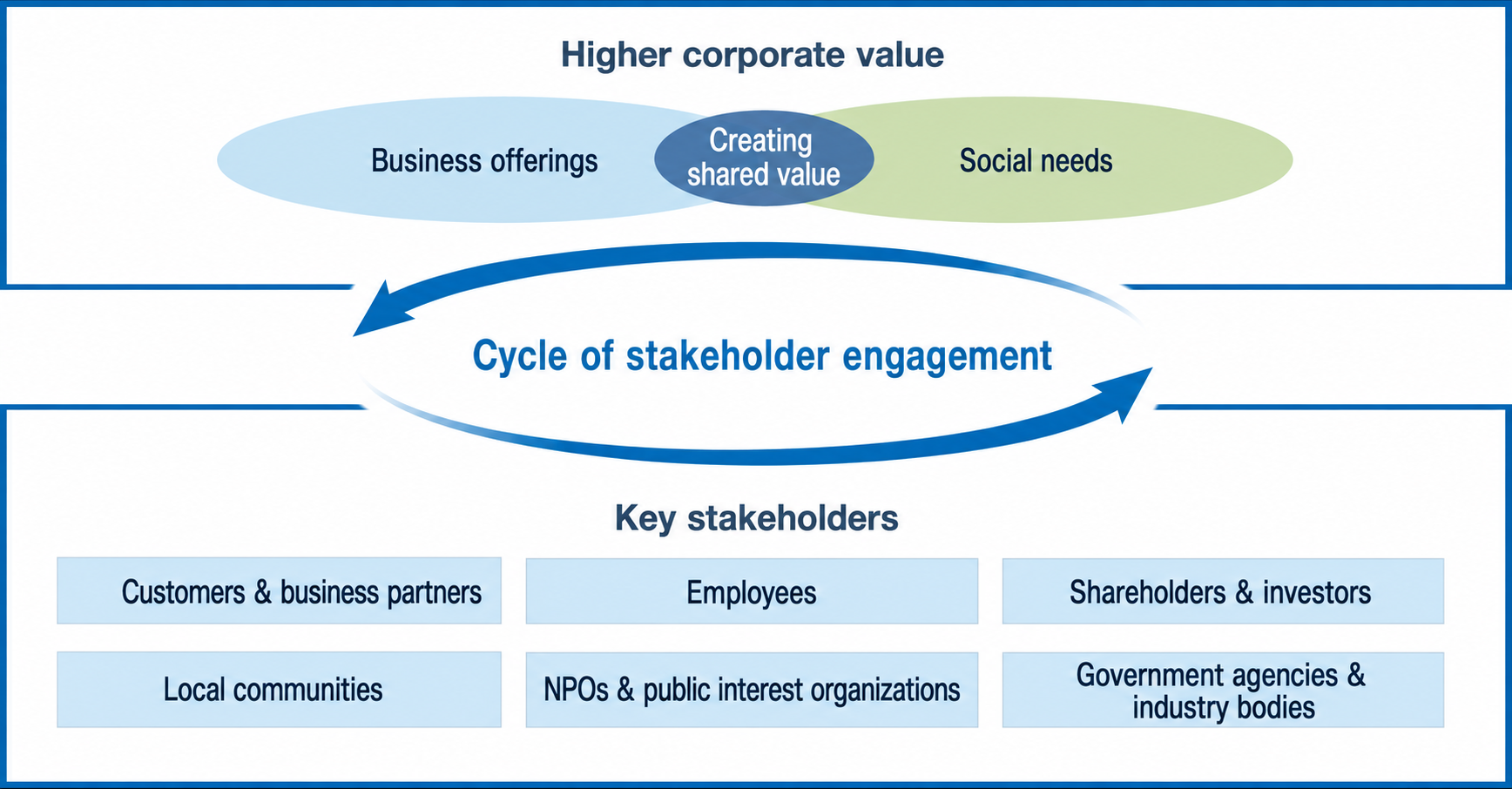
To operate sustainably, we must rigorously adapt to evolving social and market environments in alignment with stakeholder expectations. This is why we engage with a wide range of stakeholders from customers and business partners to employees, shareholders and investors, local communities, NPOs and public interest organizations, government agencies and industry bodies. Maintaining active communication helps us identify shared challenges in society and understand what our stakeholders expect of our business, so that we can review internally to incorporate it into our business. By capturing and acting on stakeholder feedback and co-creating value with our stakeholders, we aim to contribute to a better and more sustainable world while growing our business sustainably.
Stakeholder Engagement
Basic concept
Our key stakeholders
Customers and business partners
We provide products and services for customers from upstream to downstream industries, meeting their needs and contributing to social and economic development in collaboration with strategic partners. Customers and business partners are important stakeholders in our efforts to achieve sustainable supply chain management at the global level.
- Key engagement methods
-
- Website and corporate profile, publicly available in different languages
- Hotline for collecting feedback and answering inquiries
- Showroom space for interactive experience
- Surveys and discussions on supply chain management
- Knowledge platform offering product and industry application expertise
- Relevant matters
-
- Quality and usability of products and services
- Human rights and environmental due diligence in supply chain
- Sustainable procurement
- Knowledge sharing and partner training
- Follow-up actions
-
- Improve supply chain management and enhance quality and quantity of information disclosed based on stakeholder feedback
Employees
We believe that employees are one of our greatest assets and provide opportunities for them to take on new challenges and grow professionally as our business diversifies and globalizes. Across our group companies, we help employees understand our corporate values, motivating them to put our corporate motto of Ceaseless Creativity into practice and participate actively at work.
- Key engagement methods
-
- Teiho and other in-house systems to compile intelligence from employees
- Annual employee engagement survey
- Workshops and staff meetings
- Relevant matters
-
- Workplace satisfaction and engagement
- Workstyle innovation and productivity improvement
- Talent and career development
- Follow-up actions
-
- Empower employees to lead projects for improving quality and speed at work
Example of employee engagement
Since April 2023, a team of about 20 employees has been involved in streamlining in-house meetings to improve workstyles and productivity. The project involves setting meeting guidelines and promoting their use at our Japan offices, so meetings are conducted more smoothly.
Action summary
How do we avoid poorly conducted meetings that run over and end without a decision? Employees interested in addressing such common problems formed a project team to discuss and set rules and best practices that would reshape our meeting culture. They suggested, for example, that employees should clarify meeting objectives and agendas before meetings and participate in meetings, knowing what is expected of them and respecting the limited time. To boost awareness of efficient meeting practices, the project team also printed stickers and posters for meeting rooms and distribution to employees.
Employee feedback on the meeting guidelines
- We engage in more focused, quality discussions when we specify our goals before the meeting.
- Meetings moved along faster after we kept the number of participants small.
- We starting using timers at meetings, which improved our time management.
- Assigning clear tasks with deadlines for specific owners at the end of meetings helped improve accountability and follow-through.
We conduct briefings and one-on-one meetings to make timely and appropriate disclosure of information that shareholders and investors can use to better understand our business policies and activities. Through these dialogues, we incorporate their ideas and requests into our business to help enhance corporate value over the medium to long term.
- Key engagement methods
-
- Briefings and meetings with analysts and institutional investors
- Annual general meeting of shareholders
- Securities report and integrated report
- Financial results briefings
- Briefings to explain our business
- Relevant matters
-
- Medium- to long-term growth strategies
- Capital efficiency and shareholder returns
- ESG and sustainability initiatives
- Follow-up actions
-
- Use shareholder/investor feedback to improve information disclosure and review our capital allocation strategy
Local communities
We strive to coexist with local communities in the countries and regions where we operate, contributing to the sustainable growth and development of their economies and society through our business and CSR activities.
- Key engagement methods
-
- Activities that give back to local communities and protect the environment
- Collaboration with educational institutions (to provide guest lectures, etc.)
- Relevant matters
-
- Community needs and challenges
- Education and support programs for future generations
- Follow-up actions
-
- Use what we learn from dialogues to identify priorities for CSR activities and how we can better benefit local communities
NPOs and public interest organizations
NPOs and public interest organizations are important stakeholders that pursue specific social and environmental causes. We value their feedback, using it to improve our strategies and drive collaborations for solving social and environmental issues.
- Key engagement methods
-
- Projects with NPOs
- Donations and CSR activities
- Relevant matters
-
- Social inclusion
- Education for future generations
- Environmental and social problems
- Follow-up actions
-
- Cultivate young children's interest in science, technology and invention
- Co-create with people with disabilities, exploring how we can translate lived experiences into new products and services
- Playing our part in the world (Gold Ribbon Walk)
Example of NPO engagement
From May 2023 to January 2025, a team of 46 employees in Japan worked with 14 individuals with visual, hearing and developmental disabilities on a project to build a more inclusive society through the NPO People Design Institute. This is part of our efforts to integrate diversity, equity and inclusion into our business.
Action summary
Project members held study sessions and dialogues to better understand the barriers people with disabilities face in their daily lives. For example, they learned that some people can feel overwhelmed by large amounts of written information, which makes it difficult to find exactly what they need. They also learned that some frequently misplace their belongings or are looking for ways to navigate museums and art galleries safely and comfortably on their own.
In addition, members did fieldwork, accompanying people with disabilities on their shopping and other routines to experience situations in which they need assistance, such as when accessing information. They then conducted workshops to discuss and think up potential solutions that leverage the company’s strengths in auto-ID technologies. Ideas include solutions for providing personalized audio guidance, locating misplaced items, and making arts and culture more accessible.
Out of these ideas, two have made it to the stage where we are now assessing their potential for commercialization in greater detail. With our technologies and expertise, we will continue working with people with disabilities to seek their input in developing solutions that create new value and overcome challenges to build a more inclusive society.
Government agencies and industry bodies
We work with government agencies and industry bodies to support the sound development of our industry and address shared challenges in society.
- Key engagement methods
-
- Involvement in working groups and government committees
- Activities organized by industry bodies
- Relevant matters
-
- Industry standards and regulatory trends
- Environmental actions and recycling
- Follow-up actions
-
Use the insights gained to elevate business operations and environmental actions