

Group CFO Message

What achieving sustainable growth entails
At SATO, we steadily increase our value over the long term through innovation. We believe in redesigning the movement of people, things and information to transform how industries operate starting from their front lines. This led us to invent the handheld labeler in 1962 and thermal transfer barcode label printer in 1981, setting new standards for retail and logistics at the time.
To carry forward our heritage, our medium-term management plan positions Perfect and Unique Tagging (PUT) as a central theme driving the next wave of innovation. PUT is a long-term initiative that aims to create new value by expanding item-level information management. As results will not emerge overnight, we must continue refining its real-world application through repeated testing. Pursuing PUT will require a strong financial foundation and robust management systems capable of supporting ongoing innovation.
For any global business, managing business opportunities and governance risks across regions is no easy task. We will strive to strengthen our management fundamentals from both financial and governance perspectives so that we can make better, quicker grouplevel decisions while operating at the right size to achieve sustainable growth globally.
Strengthening financial governance and corporate management
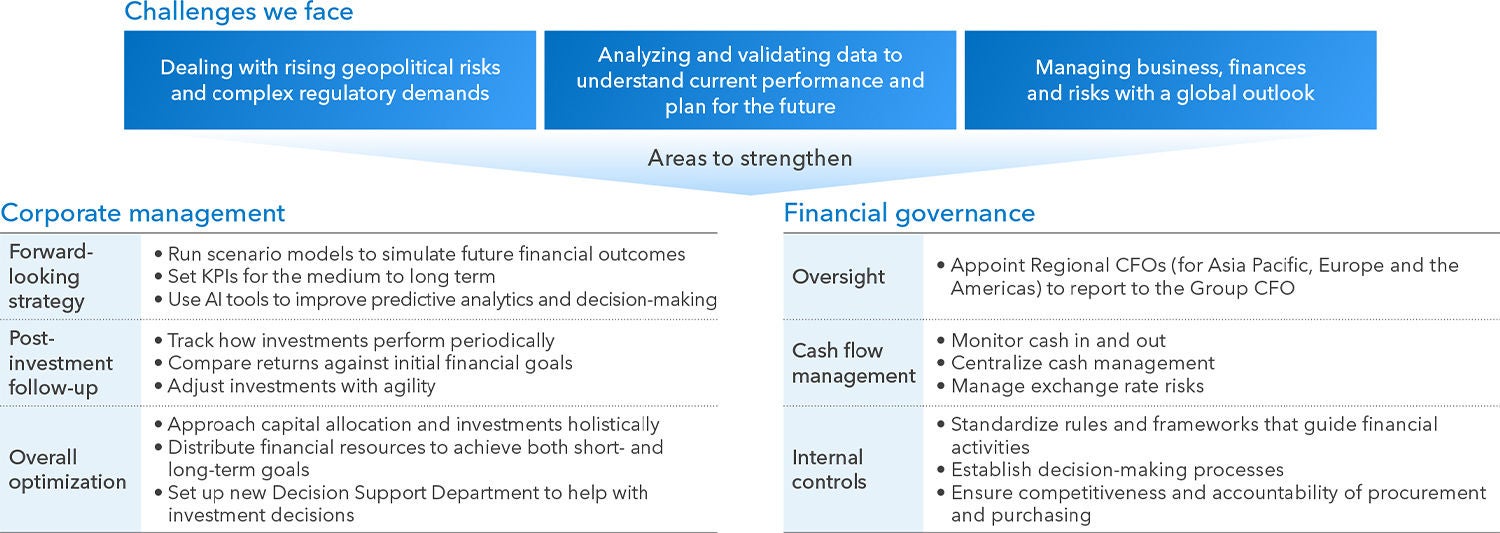
For a start, SATO must strengthen its ability to generate cash to achieve medium-term growth. Placing ROIC discipline at the core of our financial strategy, we will seek both profitability and capital efficiency to drive better business management. While the importance of operating income is now well-recognized across the company, we can do more to raise awareness of invested capital, particularly with a focus on shortening our cash conversion cycle. We will also steadily implement measures such as optimizing product lineup and enhancing demand-forecasting accuracy to generate more cash and appropriately reallocate it to growth areas, thereby improving our capital efficiency and business portfolio.
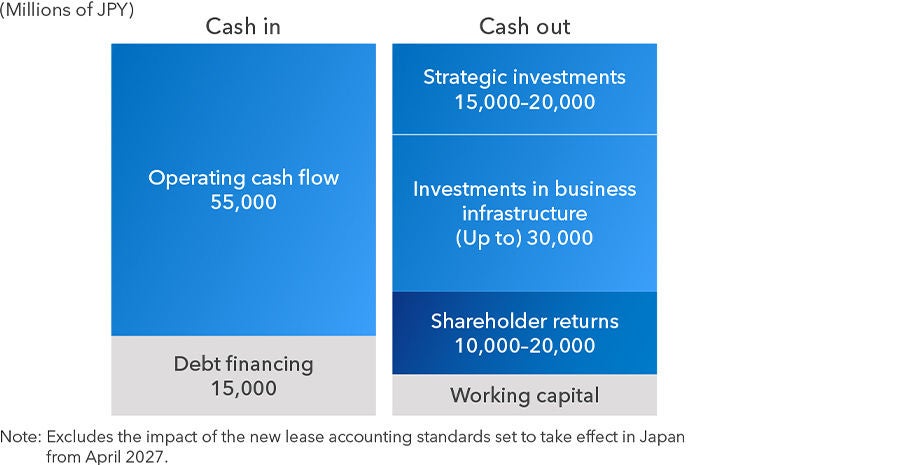
Capital allocation for FY 2025 to 2028
To deliver these measures effectively on a global scale, SATO appointed Regional CFOs in April 2026 as part of its new framework for monitoring days inventory outstanding (DIO), days sales outstanding (DSO) and days payable outstanding (DPO) as common KPIs for cash conversion. In addition, we established a Financial Planning Department to enhance both our financial planning and analysis (FP&A) and treasury functions. The Japanese headquarters office will work closely with our different subsidiaries to accelerate improvements tailored to local challenges and strengthen financial governance.
In FY 2026, we created a new Corporate Management HQ to head our finance, legal, governance and general affairs departments, under the oversight of the Group CFO. With these departments working together in developing and enforcing the overarching systems that regulate and protect our business, we can make investment decisions or manage risks in a faster and more consistent manner. We recognize the importance of following up on growth investments and will work on building a more disciplined investing process. We will also introduce digital tools for accounting and other financial processes to help relevant departments timely share numbers and insights for better corporate management and decision-making.
Managing investments carefully is important, too. An earlier investment we made for replacing internal systems led to an impairment loss of approximately 1.3 billion yen in FY 2025. We must strengthen discipline and oversight to ensure the same does not happen again.
To stabilize our business fundamentals, we must maximize our capital efficiency while minimizing financial risks. We will centralize cash management and work toward overall optimization.
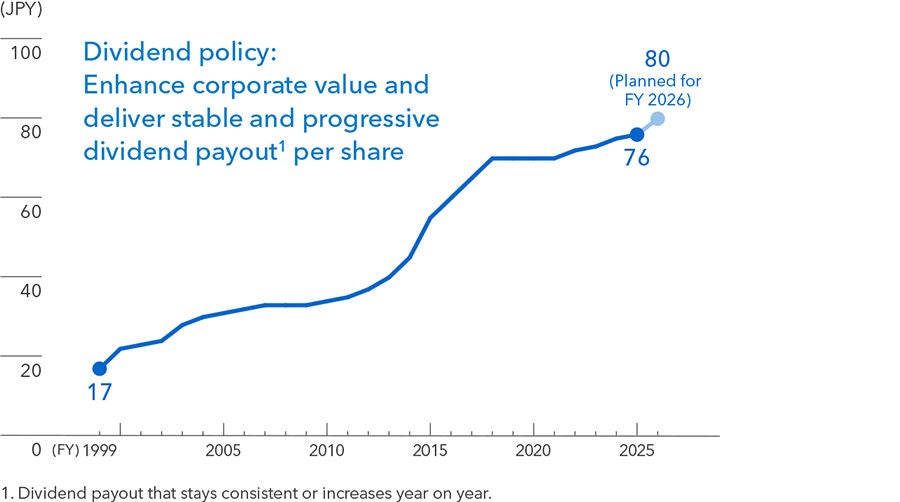
And to diversify our financing options, we have obtained a new A− rating (previously BBB+) from the Japan Credit Rating Agency. This will not only facilitate our access to capital markets for stable funding but also improve stakeholders’ understanding of our financial strengths and creditworthiness, when combined with equity analysis. Currently, our price-to-book ratio, which is tied to capital efficiency and growth expectations, is below 1.0. Besides raising our capital efficiency, we plan to steadily implement growth investments and engage with capital markets by communicating our upside potential. We are committed to long-term profitability and shareholder returns (as set forth in our dividend policy) and will keep up efforts to strengthen cash generation and governance safeguards to earn the trust of our investors.
Dividends per share
Osamu Masuko
Group CFO
Executive General Manager of
Corporate Management
Oversees compliance
SATO Corporation