

The SATO Group puts contributing to society through business — the aspiration of company founder, Yo Sato — at the heart of our corporate values, and seeks to realize this under our corporate motto of Ceaseless Creativity. People enjoy better standards of living than ever, but this comes at serious cost to the environment as sustainable maintenance of nature itself is under threat. SATO recognizes that decarbonization, the circular use of resources and maintenance of biodiversity are urgent priorities for society. Thus, we continuously strive to contribute to a more sustainable world through our business with Ceaseless Creativity.
Carbon Neutrality Declaration
What we envision
Contributing to society through our business
SATO's history began with hand labelers that tag price labels to retail goods. We have since been engaged in what we term “tagging,” drawing on a range of auto-ID technologies including barcodes, 2D codes, RFID, location tracking and sensors, and honing how we tag information to each 'thing' to capture its attributes, status, location and movement to make good use of this data.
Through tagging, we help businesses ensure accuracy, save labor and resources, offer reassurance, enable sustainable practices and build emotional connections. Providing this value to society through our business is our legacy and always at the core of what we do.
Our policy for decarbonization
We aim to reduce greenhouse gas emissions, including carbon dioxide, not only from our own operations (Scope 1 and 2) but also from our supply chain (Scope 3) by sharing expertise in decarbonization with suppliers.
We also help customers reduce emissions at their worksites through the products and solutions we provide.
Our carbon neutrality declaration
FY 2030 target
Reduce Scope 1 and 2 emissions globally by 50 percent from FY 2019 levels.
We will provide progress updates as part of our external reporting, including in our annual Integrated Report.
FY 2050 target
Reach net zero by using carbon removal credits to offset Scope 1 and 2 residual emissions.
Based on FY 2019 data, these unavoidable emissions are estimated at about 10 percent of our total Scope 1 and 2 emissions.
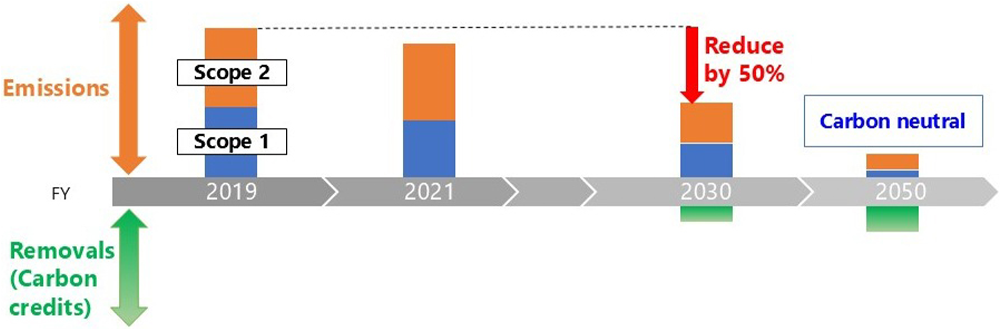 Our decarbonization targets
Actions for reducing Scope 1 and 2 emissions
(1) Expand use of renewable energy
- Install solar panels and other renewable energy generating systems
- Lower the emission factor for purchased electricity by contracting with renewable energy providers
- Increase renewable fuels, resources and heat consumption
- Make strategic use of renewable energy certificates
(2) Promote energy efficiency and conservation
- Introduce energy-efficient facilities
- Streamline our internal value chain, with a focus on the production process
- Switch to biofuels
- Replace company cars with eco-friendly vehicles
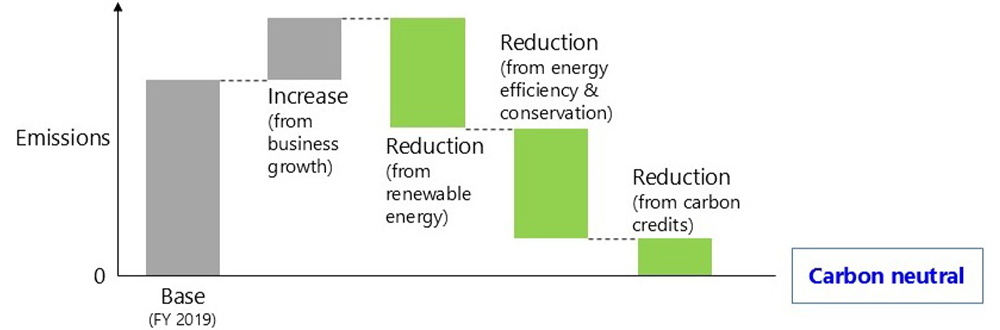 Our emissions projection, with reductions for reaching net zero
Target and plan for Scope 3 emissions
FY 2030 target
Reduce emissions by 30 percent from FY 2019 levels.
Plan
There are three emission categories that account for the bulk of our total Scope 3 emissions.
For Category 1 (Purchased goods and services), we will continue working with key suppliers to better understand actual emissions through information sharing and dialogue, while building a collaborative framework for future emission reductions. We will also reduce the use of new resources and associated emissions by utilizing refurbished components.
For Category 11 (Use of sold products), we will work to reduce electric usage to lower emissions.
For Category 12 (End-of-Life treatment of sold products), we will promote collection and recycling initiatives, encourage resource circulation and reduce the environmental impact of waste disposal.
Through these efforts, we aim to cut emissions across the entire product life cycle to achieve our Scope 3 reduction target.
Commitment to realizing a decarbonized society
We help customers reduce greenhouse gas emissions at their worksites (also known as Scope 4) through the products and solutions we provide.
Examples of what SATO's solution can do
- Automate manual tasks to save workers time
- Reduce food waste and other kinds of waste
Quantifying the decarbonizing impact of our solution
- Use a consistent methodology to calculate emissions that can be avoided from using our solution
- Assess total avoided emissions of all solutions sold (Planned)
Long-term target
- Add Scope 3 and 4 emissions to our carbon neutrality plan and aim to become carbon negative
- Scope 1 covers direct emissions from company-owned sources (e.g., emissions associated with fuel combustion or industrial processes).
- Scope 2 covers indirect emissions from the consumption of purchased energy including electricity, heat and steam.
- Scope 3 refers to emissions indirectly linked to the company through its value chain; it includes all sources not within Scope 1 or 2.