Release

SATO Publishes Results of Digital Product Passport Proof of Concept

Expanding reused materials through DPP model for end-to-end data visibility of dismantling and recycling of printers 

SATO Corporation,  today announced the results of a proof of concept (PoC) conducted jointly with Nakadai Holdings Co., Ltd. and RadarLab Co., Ltd. in Japan toward the implementation of a Digital Product Passport (DPP).

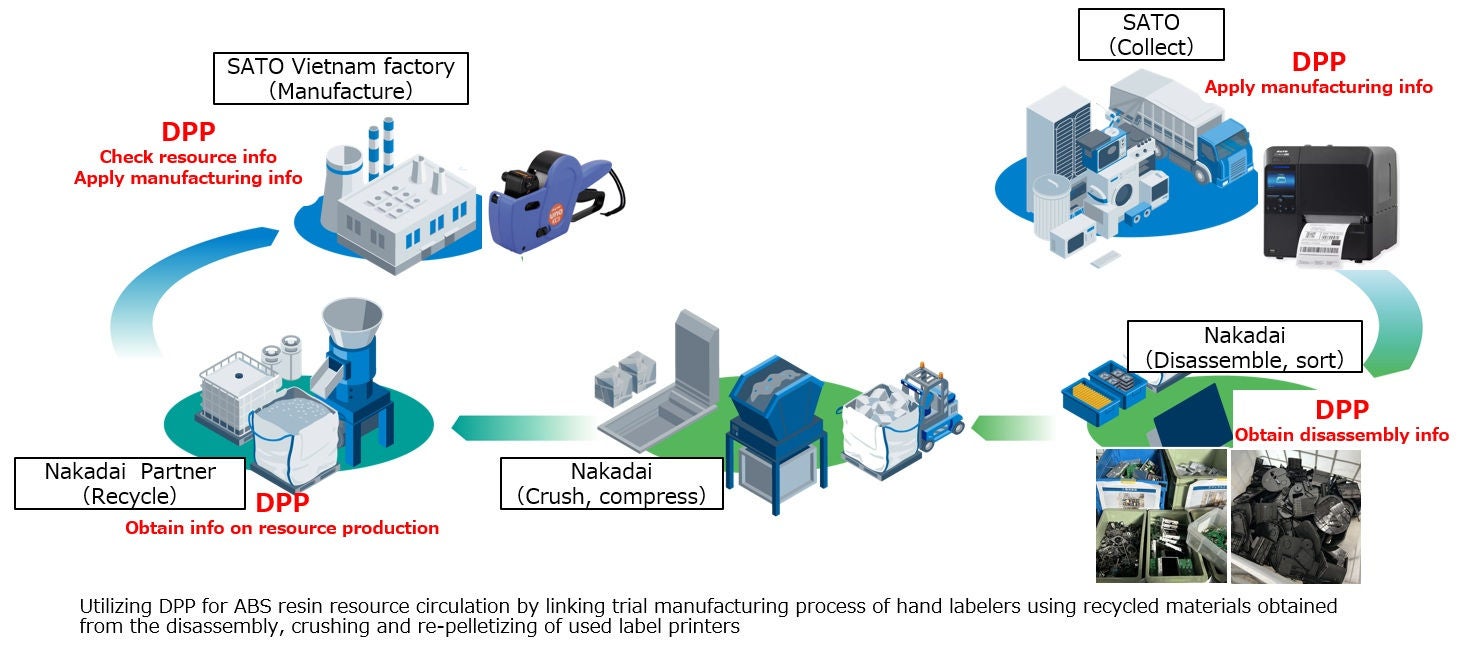
In this PoC, a label printer scheduled for disposal was used to validate end-to-end data linkage across the lifecycle—from manufacturing and distribution through dismantling and recycling, and onward to trial production of a handheld labeler using recycled materials—confirming the effectiveness of a cross-company resource circulation model.

Background

As the shift toward a circular economy accelerates worldwide, lifecycle-wide data accessibility and transparency have become urgent priorities. In Europe, regulatory frameworks are progressing rapidly, including the EU Battery Regulation, which entered into force in August 2023, and the expected mandatory adoption of battery passports by 2027. These developments are driving efforts to centrally manage data from manufacturing through recycling.

In Japan, DPP implementation efforts are advancing, but many initiatives remain limited to manufacturing-stage or data-focused PoCs, and end-to-end data connectivity across manufacturing, logistics, and recycling has not yet been achieved. Variations in the level of digitalization of processes often fragment information, reducing value-chain visibility and hindering broader adoption of recycled materials and resource circulation.

In Japan, DPP implementation efforts are advancing, but many initiatives remain limited to

With Europe leading the institutionalization of DPP frameworks, Japanese companies are urgently establishing cross-company data foundations to accelerate the social implementation of DPPs domestically in order to maintain global competitiveness.

About the trial

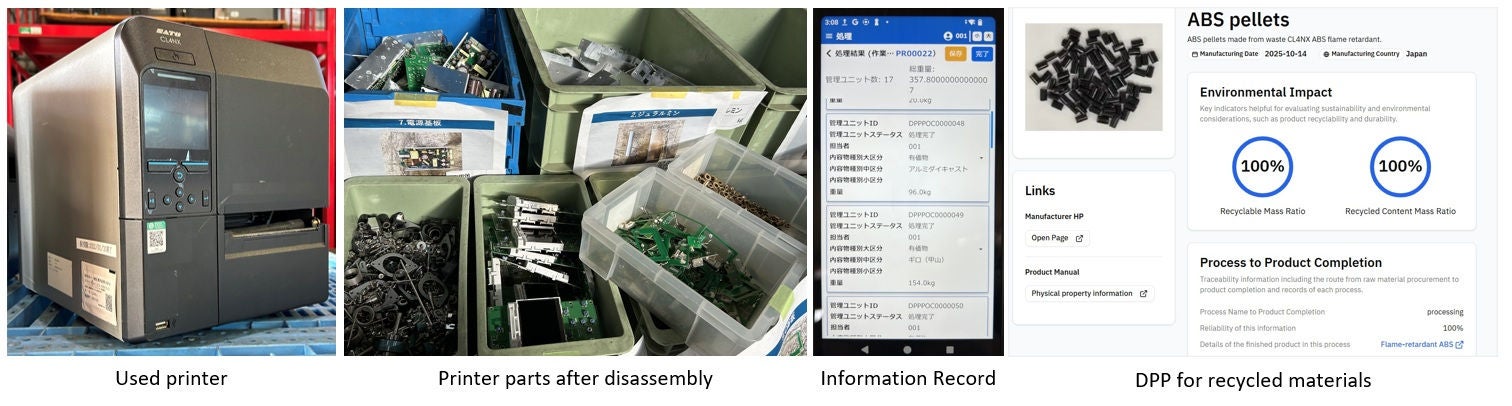
This PoC applied a DPP to a SATO label printer and evaluated operational methods and the effectiveness of information utilization across the full process—from collection of used products to dismantling and shredding, recycling of ABS resin, and trial manufacturing of a handheld labeler using recycled materials.

The PoC was conducted from October 6 through the end of November 2025. By integrating data captured at each stage and linking it with manufacturing-stage information, the PoC verified feasibility as a cross-company resource circulation model.

Key outcomes

In this PoC, a DPP was introduced across the full set of processes—from manufacturing through dismantling and recycling—to comprehensively evaluate technical and operational requirements for a cross-company resource circulation model. The following outcomes confirmed the effectiveness of the approach:


1. End-to-end data connectivity across manufacturing, recycling and reuse

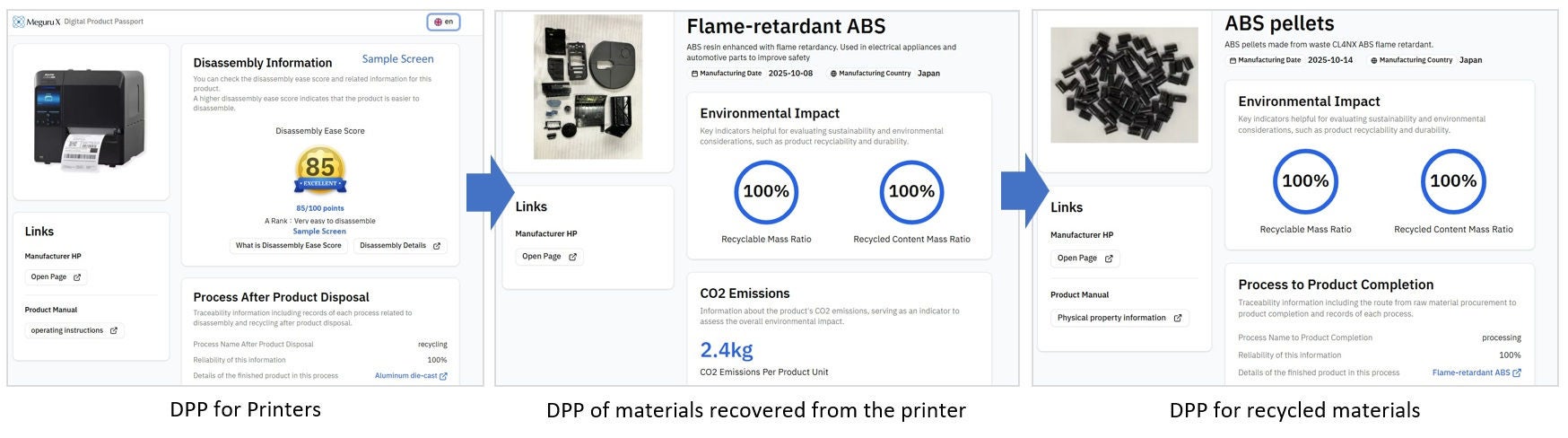
The PoC demonstrated that manufacturing information, material information, and dismantling procedures for the label printer can be linked with external systems and referenced centrally through the DPP. The PoC also confirmed that real operational data—such as dismantling time, collection rates, recycled material weight, and color—can be captured, enabling quantitative evaluation of dismantling processes.

Additionally, by displaying linked data on the DPP, the PoC showed that traceability down to the product serial number is technically feasible. This improves transparency regarding the origin and quality of recycled materials, strengthening corporate accountability in ESG and procurement domains.

2. Operational efficiency and quality improvements at recycling sites

By leveraging DPP information, recycling and dismantling sites can access material and structural information in advance, enabling clearer dismantling procedures and reducing wasted effort. The PoC also confirmed the potential to minimize contamination and defects during material sorting, contributing to more stable recycled material quality and faster processing. These results demonstrate the value of shifting from experience-dependent operations to data-driven, efficient, and highly reproducible processes.


3. Addressing structural issues that prevent broader use of recycled materials

A common barrier to the adoption of recycled materials is the lack of essential information: material origin, strength and quality, and processing history. The PoC confirmed that this data can be captured and managed centrally through the DPP, meeting key requirements for advanced use of recycled materials.

This model may also be applicable across a wide range of industries—including automotive, home appliances, and consumer goods—to support broader adoption of recycled materials and circular resource flows.


4. Practical feasibility of item-level traceability management using unique product IDs

By integrating SATO’s expertise in linking physical items with information, Nakadai’s recycling field operations, and RadarLab’s DPP system, the PoC confirmed that centralized management starting from unique product IDs is feasible. The PoC demonstrated that processes across manufacturing, dismantling, and resource recovery can be linked through IDs, enabling full traceability.


5. Step-by-step data connectivity for scalable adoption

Even if data formats are not unified across stakeholders, the PoC demonstrated that linkage can begin using commonly available formats such as CSV files. This presents a realistic DPP operational model with a low barrier to adoption, enabling companies to implement initiatives gradually.


6. Applicability of universal standards

The PoC applied a data structure based on the UN Transparency Protocol (UNTP) international standard to a SATO printer and confirmed that it can operate seamlessly with Japanese product specifications. These results indicate that the model has the universality required for deployment across other industries as a Japan-origin DPP implementation model.


Resource reuse for industrial transformation

The insights from this PoC go beyond improving individual recycling steps. They also show how industry could change in the future.

First, the PoC confirmed that data can be managed consistently across the full lifecycle—from manufacturing and use to collection, dismantling and reuse. This makes it more realistic to build circular economy models that work in practice. It also showed that companies can share and use data across different stages, for practical cross-industry resource circulation.

Also,as DPP-based data connectivity expands, information collected during recycling can be fed back into product design. This can support continuous improvements, including more environmentally friendly designs and products that are easier to dismantle and recycle.


New issues and next steps

Through this PoC, SATO identified new challenges that industry must address:


1. Systematizing a shared “circular design philosophy”

·        Approaches to circular design (material selection, dismantlability, and design for recyclability) differ by company

·        Information required by recyclers and resource manufacturers (materials, structure, additives, etc.) has not been standardized

2. Standardizing DPP profiles to enable interoperability between product data and waste data

·        Differences in formats for Bills of Materials and material information

·        Variability in the granularity and collection methods of waste-related data

3. Reducing input burdens caused by manual operations in collection, processing, and recycled material production

·        Sorting, weighing, and recording are often performed manually

·        Automated measurement and recording, standardized ID assignment, and standardized labeling operations are essential

4. Clarifying traceability operational models

·        Industry-level agreement is needed on tracking units (e.g., component-level vs. lot-level traceability)

5. Standardizing quality criteria for recycled materials

·        Required quality indicators differ across manufacturing companies and products


These are only some of the challenges identified, and we will continue to tackle them with an emphasis on cost transparency and long-term sustainability in circular business.


SATO will build on the insights and challenges identified through this PoC and will continue its efforts to drive the social implementation of DPPs and resource circulation.